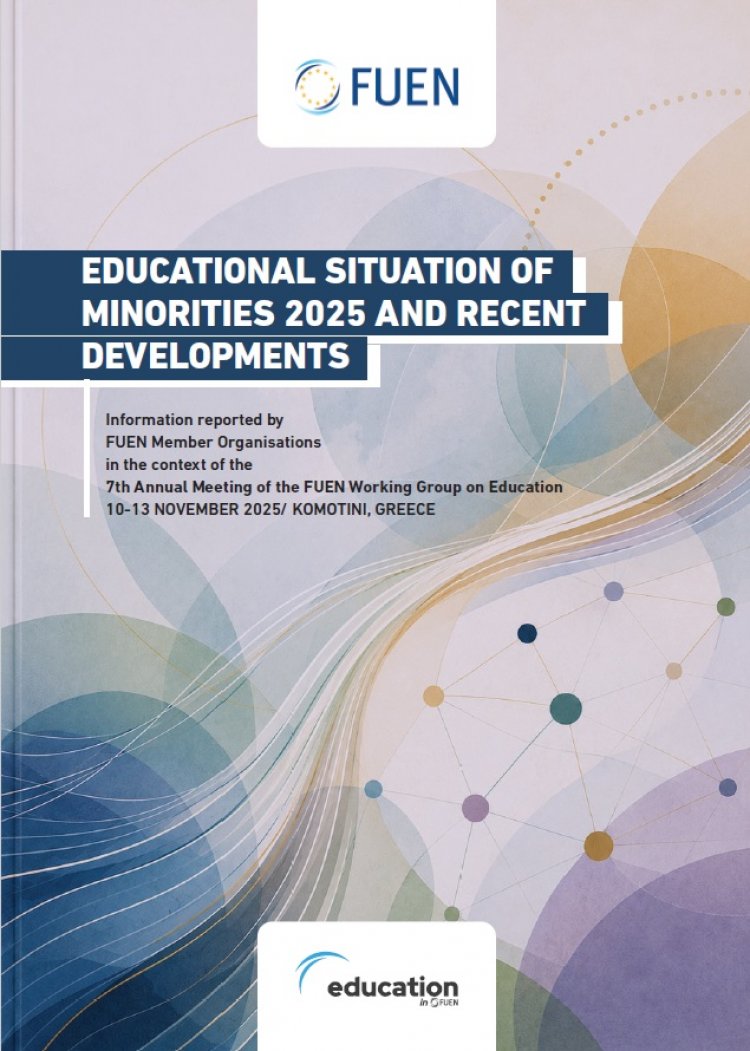
The report titled “Educational Situation of Minorities 2025 and Recent Developments’’, prepared by the Education Working Group of the Federal Union of European Nationalities (FUEN), has been published.
Prepared based on information provided by member organisations regarding the educational situation of ten national minorities in eight European countries—who contributed to the FUEN Education Working Group meeting held in Western Thrace on 10-13 November 2025—the report also addresses the challenges faced by the Turkish Minority in Western Thrace in the area of education.
The report notes that while the education systems available to national minorities in Europe vary significantly from country to country, many national minorities face common challenges. It highlights that legal safeguards alone are insufficient; political will, adequate funding, qualified teachers, and effective oversight mechanisms are necessary for the effective implementation of the educational rights of the national minorities.
The report cites the situation of the Western Thrace Turks and the Macedonians in Greece as one of the most striking examples of states failing to translate their international obligations into practice.
In the section on the Turkish Minority in Western Thrace, the report notes that despite the educational rights guaranteed by the Treaty of Lausanne, the minority’s education system has been progressively weakened over the years. The report notes that while education in Western Thrace is effectively conducted bilingually in Turkish and Greek, the state has significantly restricted the minority’s autonomy in the field of education through legal regulations and administrative practices implemented over time. The report indicates that, as a result, the state now exercises comprehensive control over the administration, curriculum, and operations of minority schools, and that the current situation has drifted away from the educational autonomy envisaged by the Treaty of Lausanne.
The report also provides a detailed account of the current problems faced by the Western Thrace Turks in the area of education. As an example, the report notes that due to the lack of bilingual Turkish-Greek minority kindergartens, children are forced to receive their preschool education exclusively in Greek. At the primary school level, the report emphasises that the continued closure of Turkish minority primary schools—cited as being due to declining number of pupils—makes access to minority education increasingly difficult with each passing year. Regarding secondary education, the report explains that the number of Turkish minority schools is extremely insufficient; that intense state control over school administration and the curriculum limits educational options; and that the absence of any Turkish minority secondary or high schools in the prefecture of Evros leads to a significant inequality. The report also notes that a demand to establish a new Turkish minority secondary and high school in Xanthi has been rejected.
Furthermore, the report notes that the Turkish communities in Rhodes and Kos in Greece, are also completely excluded from minority protection mechanisms. It also notes that all Turkish schools that operated in the past were closed in the early 1970s, and no school providing education in Turkish has been re-opened since then.
Please click below to access the full report of the FUEN Education Working Group:
https://edu.fuen.org/documents/Educational-Situation-of-Minorities-2025-and-Recent-Developments-Bildungssituation-von-Minderheiten-2025-und-juengste-Entwicklungen