International Mother Language Day 21 February!
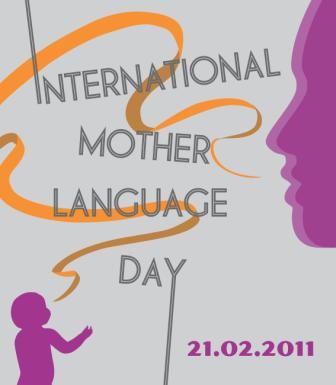
The International Mother Language Day 21 February, which was proclaimed by the General Conference of the United Nations Educational, Scientific and Cultural Organization (UNESCO) in November 1999 and has been observed every year since February 2000 to promote linguistic and cultural diversity and multilingualism, is being observed today in various parts of the world. The theme of the 2011 International Mother Language Day concerns the information and communication technologies for the safeguarding and promotion of languages and linguistic diversity. On the occasion of the 2011 International Mother Language Day, Director-General of UNESCO Irina Bokova released a message saying that information and communication technologies could be especially useful in promoting mother languages, and they had to harness the power of progress to protect diverse visions of the world and to promote all sources of knowledge and forms of expression.
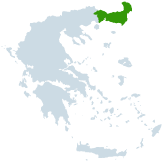
On the occasion of the 2011 International Mother Language Day, Halit Habipoğlu, President of the Federation of Western Thrace Turks in Europe (ABTTF) stated that: “The UNESCO’s Atlas of the World’s Languages in Danger designates that many languages spoken in the world are in danger of dying out. All the languages spoken in the world and linguistic diversity as being part of the world’s cultural heritage should be protected by the countries, where that or those languages are spoken. On the other hand, those langauges, which are not in danger of dying out today, but spoken by the minorities or persons belonging to a different religious or ethnic group on the territories of a country, should be protected of by special mesaures instead of being ignored or eradicated by state policies. The states should use information and communication technologies in order that these languages are transferred to the next generations. Unfortunately, we observe at this point a deep chasm between the ideal state and experiences in Greece as in many other countries. The Turkish minority of Western Thrace, which is officially recognized by the Greek State on religious basis, has autonomy in the field of education. The kindergarten problem, which has been expressed with this name recently in the public opinion, describes the problem that after the pre-school education has become cumpolsory for all pupils without taking their differences into consideration, all children in Greece has to attend now public kindergarten where the instruction is only in the Greek language. This situation seriously jeopardizes the children in early ages to learn their mother language. For this reason, we call upon the Greek government to review the existing law, and find together with the minority a solution to the problem by considering the right to educaton in mother language”.