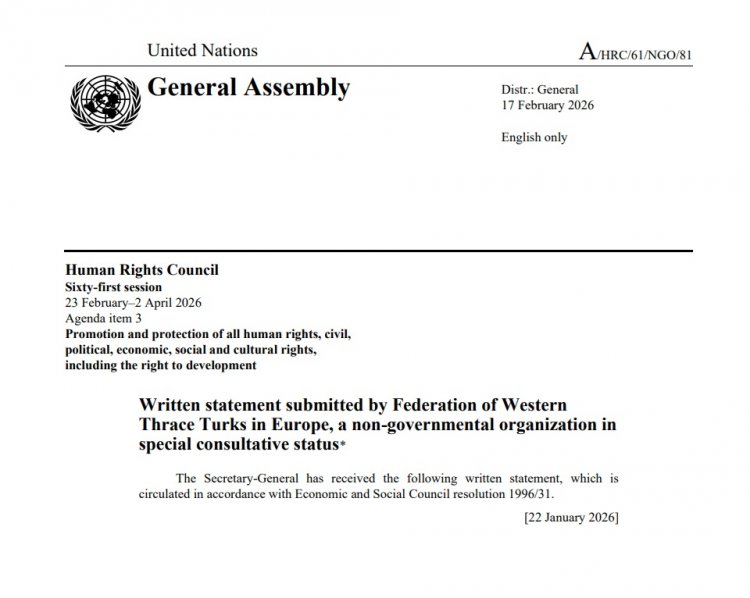
The Federation of Western Thrace Turks in Europe (ABTTF) submitted a written statement titled ‘‘Denial of Turkish Children’s Rights to Quality Education due to the Violation of the Educational Autonomy of the Turkish Community in Western Thrace, Greece’’ to the 61st session of the United Nations (UN) Human Rights Council.
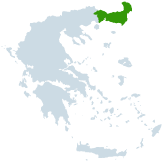
In its written statement, ABTTF emphasised that the Turkish community in Western Thrace living in Greece was granted educational autonomy by the 1923 Treaty of Lausanne, noting that within the scope of this educational autonomy, the administration and functioning of the private and autonomous Turkish schools belonging to the Turkish community is the responsibility of a school board consisting of three persons elected by the parents of pupils studying there.
Noting that the authority and responsibilities of these school boards have been restricted by the state over the years, ABTTF indicated that Law No. 694, enacted in 1977, stipulated that the three-member boards of Turkish schools were to be appointed by the governor of the prefecture from a list of up to fifteen names, and that Law No. 695, enacted in the same year, also stripped the boards of their right to hire teachers.
ABTTF explained that, despite the decision taken by the Greek Ministry of Education in 2002, the boards no longer had any authority over Turkish schools, and that although this appeared to be in line with the legal framework, arbitrary practices by the state persisted. It noted that, most recently, the board of the Xanthi Turkish Secondary and High School had been banned from entering the school building and its office inside the building had been vacated.
According to press reports, ABTTF stated that as of 1 August 2026, all school boards temporarily operating in state schools under Law No. 5056/2023 will be completely abolished and all their prerogatives and responsibilities will be transferred to the municipalities. ABTTF highlighted that if this decision is also applied to the private and autonomous Turkish schools belonging to the Turkish community in Western Thrace, it would constitute a major blow to the Turkish community’s educational autonomy.
Furthermore, ABTTF pinpointed that the government’s decision in 2010, as part of its austerity measures, to temporarily suspend the activities of schools with fewer than nine pupils and to close them permanently after three years was applied to private and autonomous Turkish schools in a manner in contradiction to the educational autonomy of the Turkish community in Western Thrace, reminding that the number of Turkish primary schools, which was 188 in 2011, had fallen to 83 in the 2025-2026 school year due to these closures.
ABTTF also added that the Turkish primary school in the village of Paleo Zigos (Mizanlı), which was effectively closed in the 2023-2024 school year due to insufficient number of pupils, did not reopen in the 2025-2026 school year despite the number of pupils reaching 10.
However, it stated that the state primary school in the village of Argiri, in the prefecture of Karditsa, reopened in 2024 with one pupil, and the state primary school on Pserimos Island reopened in 2025 with two pupils.
ABTTF emphasised that decisions regarding private and autonomous Turkish schools should belong to the Turkish community in Western Thrace and called on Greece to restore the Turkish community’s educational autonomy, which is guaranteed by the 1923 Treaty of Lausanne.
Please click below for the written statement submitted by ABTTF:
https://documents.un.org/doc/undoc/gen/g26/019/61/pdf/g2601961.pdf