Dear readers,
We are approaching the end of another year.
After a period of uncertainty and anxiety due to the pandemic, life has returned to its normal flow.
So we went back to our old busy schedule.
If I have to allude to our recent activities, I would like to mention that we paid a working visit to Strasbourg in October, parallel to the autumn session of the Parliamentary Assembly of the Council of Europe.
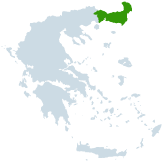
We were in our Western Thrace in the first week of November.
Our Turkic brothers from different geographies, from the Caucasus to the Balkans, came to our region for the annual meeting of the Working Group of Turkic Minorities/Communities (TAG) of the Federal Union of European Nationalities (FUEN), of which I am the spokesman.
In the two-day programne, our Turkic brothers met with the representatives of our community in Komotini and Xanthi and listened to them about our community and our issues.
I was in Athens right after.
The hearing of the claim for damages we filed against the news website newsbreak.gr, which published defamatory and false news about our Federation in 2021, took place in a high court, and our legal struggle continues.
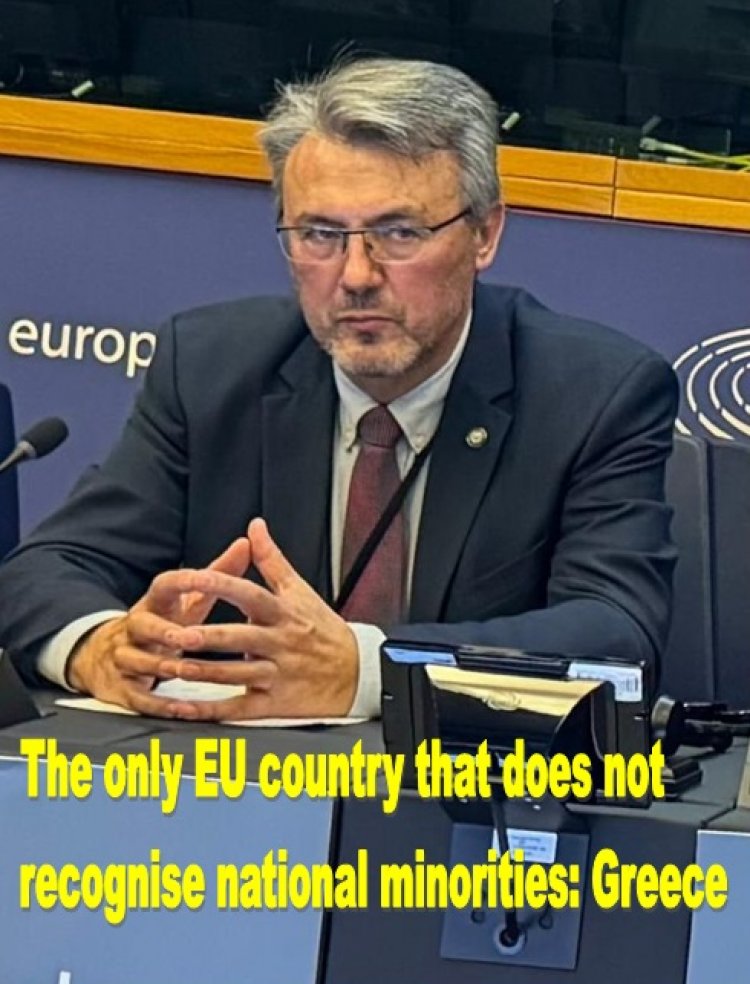
Last week we were in Strasbourg for the meeting of the Intergroup on Traditional Minorities, National Communities and Languages at the European Parliament (EP).
Our Federation, representing the Western Thrace Turks, and the Rhodes, Kos and the Dodecanese Turks Culture and Solidarity Association, representing the Rhodes and Kos Turks, conveyed the issues in the field of education in mother tongue and education to the Members of the European Parliament.
This week, we will be in Geneva for the UN Forum on Minority Issues, this time we will convey our issues on the UN platform.
In the first part of the meeting at the European Parliament in Strasbourg, the representative of the Ladin minority in Italy explained how the Ladins, while on the verge of assimilation, preserved their language and identity with the cooperation of the German minority in the region and the support of the Italian government.
The representative of the Ladin minority said that although they only have a population of 30 thousand today, their population has increased compared to the past and this is an exceptional situation among minority groups in the world!
In addition, Ladins receive education in Ladin language in all schools in the different provinces where they live within the Autonomous Province South Tyrol in Italy.
More interestingly, in all schools in the places where the Ladins live, not only members of the Ladin minority but also everyone living in that region learns the Ladin language.
Wonderful!
At the FUEN Congress held in Pécs, Hungary in September, we learned that there are 13 officially recognised minorities, including the Greek minority, in Hungary, which became a member of the EU during the great wave of enlargement.
The Greek minority is the smallest minority in Hungary in terms of population; according to 2011 data, their population is only 4,700.
However, Greeks have their own kindergarten, primary school and secondary school, as well as their own cultural house, library, cultural institute, research institute and theatre.
Like other recognised national minorities in Hungary, the Greeks can elect their own nationality delegates to the Hungarian National Assembly every four years.
On the other hand, let's look at Albania, which wants to become a member of the EU.
Greeks living in Albania constitute 1 percent of the population in Albania, and according to 2011 official figures, their approximate population is 25 thousand.
According to the latest census conducted by the umbrella organisation of the Greek minority, ‘‘Democratic Union of the Greek Minority – OMONOIA’’, it is indicated that the population of Greeks has increased to 287 thousand.
The Greek minority, which is the largest among the 9 minorities in the country, is officially recognised by the state.
Greeks are provided with education in both Greek and Albanian in the minority areas; there are also kindergartens, primary/middle schools and high schools where instruction is provided in Greek.
Let’s look at the three countries, one of them is Italy, an old member of the EU; the other is Hungary, which became a member of the EU in 2004; Albania is a candidate country currently negotiating membership negotiations with the EU...
The rights of minorities in all three countries are far, far ahead of Greece, which became a member of the EU in 1981 and boasts of being the cradle of democracy!
So why does our country not accept the existence of the Turkish minority that has lived in these lands for centuries?
Unfortunately, Greece is the only country in the 27 member EU that, far from recognising national minorities, tries to hide their existence, ignores them, and tries to assimilate them by ignoring them!
However, we, the Turks, exist in this land!
It's not just the Turks!
There are also Macedonians, Vlachs, Cham Albanians and Armenians in this country!
Greece is an EU country, but it is far, far away from the EU’s values!
With a spoiled attitude, it continues to disregard EU values with the belief that its place in the EU family will not be shaken.
Since this is the case, we will continue to do what we know.
We will continue to claim at the international level that the situation in Greece is not at all what our country shows.
We will work with the same perseverance, determination and discipline in 2024!
I would like to take this opportunity to wish everyone a happy new year and hope that 2024 will bring health, happiness, peace and well-being to everyone.
Greetings and Yours sincerely,
Halit Habip Oğlu
ABTTF President